
The Strategy Execution Bridge: Why Strategy Fails in the Middle

Most organizations don’t struggle with strategy—or effort.They struggle with the connection between the two.
The Missing Link
Most organizations don’t struggle with strategy.
They have clear plans, defined priorities, and strong intent.
They also don’t struggle with activity.
Teams are busy, committed, and working hard to deliver.
And yet, results often fall short.
Because the gap isn’t at the top or the bottom. It’s in the middle.
What Is the Strategy Execution Bridge?
Across organizations of all sizes and sectors, a consistent pattern emerges:
Strategy is defined at the leadership level.Execution happens across teams and functions.
But the connection between the two is often unclear, inconsistent, or assumed.
This is what I refer to as the Strategy Execution Bridge.

When the bridge is strong:
Priorities are clearly translated into operational goals
Decisions align with strategic intent
Measures reflect what truly matters
Teams understand not just what to do, but why it matters
When the bridge is weak or missing:
Priorities compete rather than align
Measures drive unintended behaviours
Effort is high, but impact is diluted
Frustration grows at all levels
What Builds the Bridge?
Strengthening this connection requires more than communication.
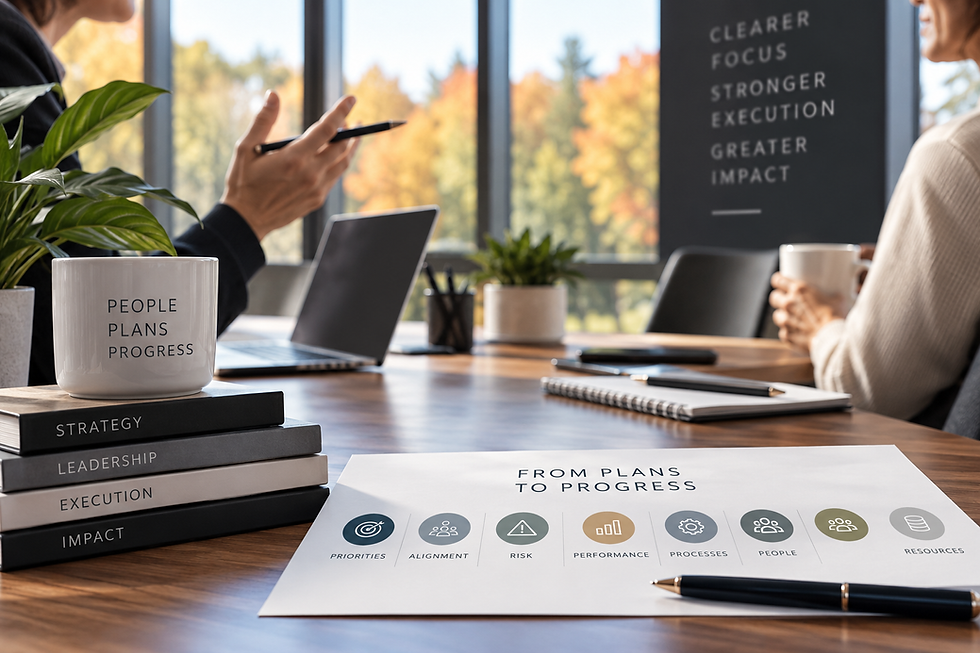
It involves deliberate alignment across key areas:
Clear line of sight from strategy to day-to-day work
Consistent decision-making frameworks, including risk and trade-offs
Aligned measures and dashboards that reinforce priorities
Defined ownership for translating strategy into execution
Regular feedback loops to adjust and improve
This is where structured approaches—such as Excellence Canada’s Organizational Excellence Standard (OES), EPIC (Excellence, Productivity and Innovation), and ISO Standards (International Organization for Standardization)—can play a valuable role.
Importantly, organizations don’t need to take on everything at once. Many begin by strengthening a single area—such as decision-making, performance measurement, or risk management—and build from there.
A Practical Opportunity
The opportunity is not to redesign strategy.
It is to strengthen how strategy lives within the organization.
Small, targeted shifts can have a significant impact:
Better alignment across teams
More confident decision-making
Stronger outcomes with the same effort
Final Thought
If strategy feels clear, and teams are working hard, but results are not where they should be, it may be worth asking:
How strong is your Strategy Execution Bridge?
If this is something you’re seeing, I’d be glad to compare notes or explore where alignment may be breaking down.
Many organizations begin with a focused Execution Alignment Review, or by strengthening a specific area such as risk, governance, or performance measurement.

Comments