
Fall Execution Check-In: Are You Positioned to Execute What Matters Most?


The plans are in place. Priorities have been established. Projects are underway. Teams know what they are working toward.
But as fall approaches, there is a more important question for leadership teams to ask:
Are we still positioned to execute what matters most?
Because a lot can change between the time a plan is developed and the time it needs to be delivered.
Priorities shift. New risks emerge. Projects encounter unexpected challenges. Capacity changes. Decisions take longer than anticipated. Processes that once worked well begin creating friction.
None of this necessarily means the strategy is wrong.
It may simply mean that execution needs a reset.
Why Fall Is a Natural Time to Check In
For many organizations, fall brings a noticeable acceleration in pace.
There are year-end commitments to deliver, budgets and plans for the coming year to develop, projects to advance, and operational pressures competing for leadership attention.
The temptation is to simply push harder.
But before increasing the pace, it can be valuable to step back and ask whether leadership attention is focused in the right places.
A focused execution check-in isn't another strategic planning exercise. It's an opportunity to look at what has changed since the plan was developed and determine whether anything needs to change in response.
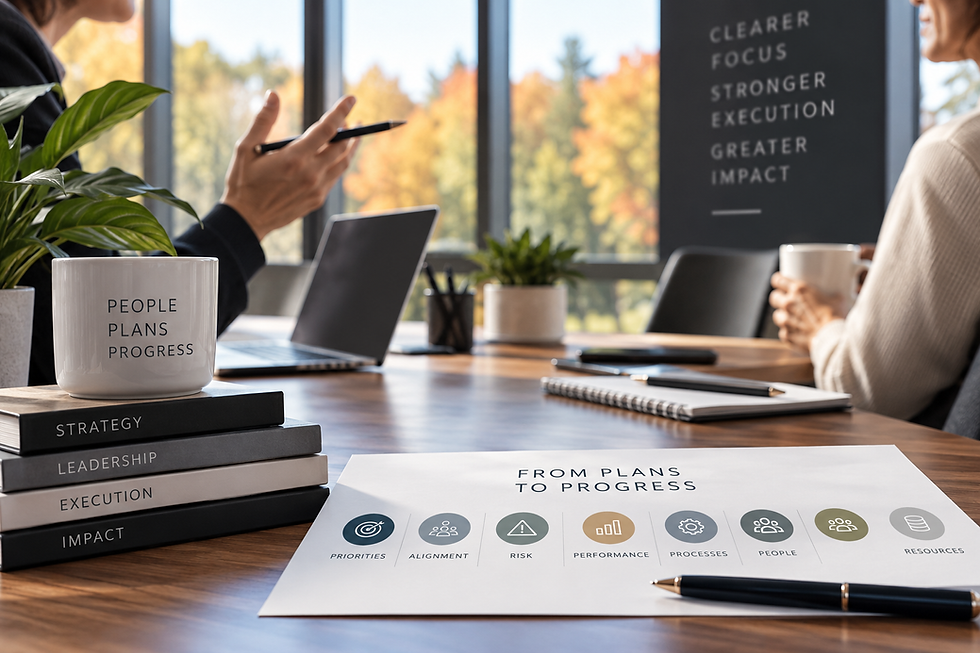
For leadership teams, six areas are particularly worth examining.
1. Priorities
Are we still focused on what matters most?
Organizations rarely struggle because they have too few priorities. More often, new initiatives and emerging demands accumulate alongside existing commitments.
A fall check-in provides an opportunity to distinguish between what remains important and what truly requires leadership attention now.
2. Alignment
Are resources, projects and leadership attention aligned with strategy?
A strategy can remain sound while day-to-day activity gradually moves away from it.
Looking at where time, capacity and resources are actually being directed can reveal whether the organization is still aligned with its intended priorities.
3. Risk & Decision-Making
What could interfere with execution — and are accountabilities clear?
Some risks are obvious. Others emerge gradually through delayed decisions, unclear ownership or unresolved issues.
Leadership teams should understand not only what could derail execution, but also who has the authority and accountability to act when something needs attention.
4. Performance
Do we know what's working, what's slipping and where attention is needed?
Good performance measurement isn't about creating more reports.
It's about giving leaders enough meaningful information to know where intervention will make a difference.
By fall, there is usually enough evidence to identify which initiatives are progressing as expected — and which may require a different approach.
5. Processes
Are our key processes enabling execution — or creating friction?
Sometimes the obstacle isn't the strategy, the people or even the resources.
It's the way the work gets done.
Unnecessary approvals, unclear hand-offs, outdated processes and duplicated effort can quietly consume capacity. Identifying those points of friction can create meaningful improvements without requiring a major organizational transformation.
6. People & Communication
Do people understand what matters now and how they contribute?
Leadership teams may have clarity about priorities without that same clarity reaching the rest of the organization.
As circumstances change, communication needs to change with them.
Employees need to understand not only what the priorities are, but what those priorities mean for their work and where their contribution fits.
The Objective Isn't More Planning
The purpose of an execution check-in isn't to reopen the strategic plan or generate another lengthy list of initiatives.
It's to create greater clarity about where leadership attention will make the greatest difference over the months ahead.
In some organizations, the conversation may confirm that execution is well positioned.
In others, it may reveal a need to strengthen operational planning, risk management, decision-making and accountability, key processes, performance measurement, governance alignment or communication.
Either outcome is useful.
Because a leadership team that knows where it stands can make deliberate choices about where to focus next.
A Focused 90-Minute Leadership Reset
The Catalyst Fall Execution Check-In is designed to make that conversation practical and manageable.
It begins with a brief, confidential Leadership Diagnostic, followed by Catalyst's review and analysis.
The leadership team then comes together for a focused 90-minute facilitated virtual session examining the six dimensions of execution.
Following the session, leaders receive a concise Fall Execution Snapshot identifying:
What's working
What needs attention
3–5 priority actions
Recommended next steps
The goal isn't a lengthy report or another planning process.
It's clarity, focus and action.
A Short Pause Can Change the Months Ahead
Organizations don't always need a new strategy.
Sometimes they need to examine what has changed, identify what is getting in the way and refocus leadership attention on the few things that will make the greatest difference.
Before the pace of fall accelerates, ask:
Are we positioned to execute what matters most through the balance of the year?
A short pause now can prevent months of working around the wrong problems.
Fall Execution Check-In
$1,500 + applicable taxes
Includes a pre-session Leadership Diagnostic and analysis, 90-minute virtual leadership session, and concise Executive Snapshot.
100% Virtual | Focused | Practical | Action-Oriented
Catalyst Performance Solutions
Catherine Neville, Principal & Trusted Advisor
Bridging Strategy and Execution

Comments